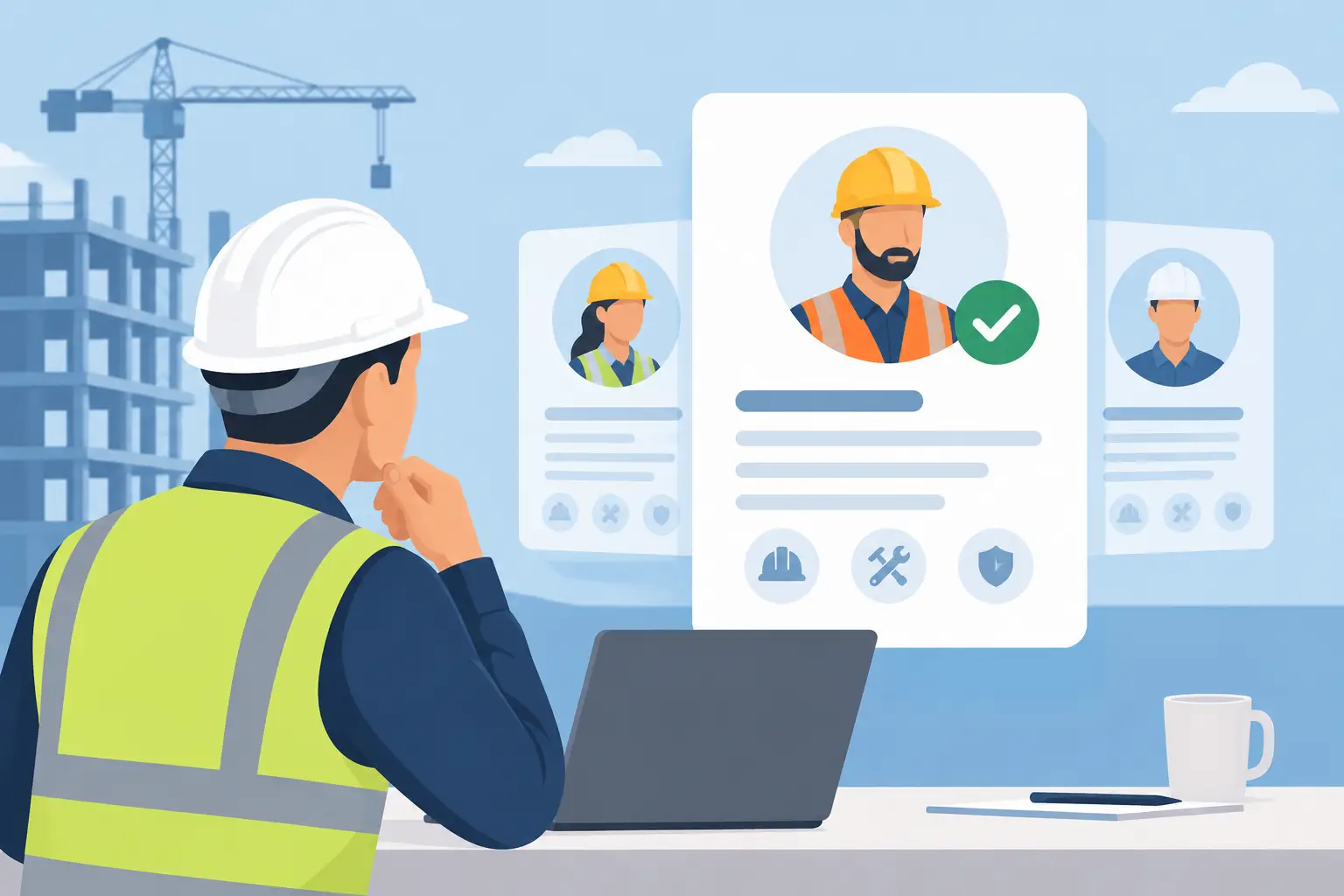

A resume that says “10 years of electrical work” will not carry much weight when a contractor needs a journeyman on site Monday morning. They need to know what that person has actually installed, whether their license is current, who can vouch for their work, and whether they can perform safely under real jobsite conditions. That is how workers prove experience in the skilled trades: with clear, job-relevant evidence that reduces risk for the employer.
For tradespeople, proof turns good work into better opportunities. For employers, it shortens the path from application to a confident hire. The strongest candidate profiles do not rely on broad claims. They show a record of completed work, validated credentials, and reliable professional relationships.
Why Experience Needs Proof on a Jobsite
Construction hiring moves fast, but the cost of a bad hire can be high. A worker who cannot read plans, operate required equipment, follow site safety rules, or complete work to spec can delay a schedule and create expensive rework. That is why experience is more than a number of years in the trade.
A five-year carpenter who has framed multifamily buildings, interpreted drawings, coordinated with other trades, and passed inspections may be a stronger fit for a commercial project than someone with more years spent on basic residential repairs. The same is true for plumbers, welders, HVAC technicians, electricians, and masons. Context matters.
Employers are usually looking for answers to practical questions: What kind of projects has this worker completed? What systems, tools, materials, or equipment do they know? Are they licensed or certified where required? Can a previous supervisor confirm their work? A worker who makes those answers easy to find stands out quickly.
How Workers Prove Experience to Employers
The most persuasive proof combines documents, work samples, and third-party validation. One item alone can help, but a complete picture gives hiring teams far more confidence.
Build a project portfolio that shows the work
Photos of finished work can say more than a generic job title. A portfolio should show projects that match the work a candidate wants next. An HVAC technician pursuing commercial work should highlight rooftop unit service, controls troubleshooting, ductwork, or commissioning where possible, not only residential maintenance calls.
Each project entry should include a short description of the worker’s role. State the project type, core tasks performed, materials or systems involved, and scope of responsibility. For example: “Installed and terminated conduit, feeders, panels, and lighting controls on a 60-unit apartment build.” That gives an employer usable detail without turning the profile into a long report.
Good photos are clear, well lit, and safe to share. Workers should avoid posting images that expose client information, security systems, plan details, or restricted jobsite areas. When photos are not available, a concise project description can still establish relevant experience.
Keep licenses and certifications current
Licenses are among the fastest ways to establish trust because they are tied to a governing authority. Requirements vary by state, city, and trade, so workers should list the license type, issuing jurisdiction, license number when appropriate, and expiration date.
Certifications add another layer of proof. Depending on the role, that can include OSHA training, EPA Section 608, NCCER credentials, welding qualifications, equipment certifications, manufacturer training, or first aid and CPR. A credential does not replace hands-on ability, but it verifies that a worker has met a recognized standard.
Workers should not overstate credentials. Saying “certified welder” without identifying the process, position, code, or current qualification can create problems during screening. Specific information is more credible and helps employers match a worker to the actual demands of the project.
Document work history with real details
Job titles in the trades are inconsistent. One company’s “electrician” may be another company’s helper, installer, service tech, or lead. A work history should clarify the level of responsibility behind the title.
For every role, include the employer, dates worked, trade specialty, and a few concrete responsibilities. Mention project environments such as residential new construction, industrial maintenance, tenant improvement, healthcare, heavy civil, or commercial service. If the worker led a crew, trained apprentices, managed material takeoffs, handled punch lists, or coordinated inspections, that belongs in the record.
Accuracy matters. Employment verification can reveal date gaps, mismatched titles, or claims that do not line up with a previous employer’s records. A gap itself is not always a problem. Workers may have traveled, cared for family, worked independently, attended training, or taken seasonal jobs. A simple, honest explanation is better than leaving an employer to guess.
Use references who can speak to performance
A reference should do more than confirm that a worker was employed. The best references can describe reliability, quality, safety habits, communication, attendance, and ability to work with a crew.
Former foremen, superintendents, project managers, shop managers, and lead technicians are often strong references because they saw the worker perform on actual jobs. Workers should ask permission before listing anyone and let the reference know what type of role they are pursuing. That makes the conversation more useful when an employer calls.
For independent contractors, references can include repeat clients, general contractors, vendors, or other trades who worked alongside them. The key is relevance. A recent reference from a comparable project is usually more valuable than a vague recommendation from ten years ago.
Prepare for skills checks and interviews
Proof does not stop at the profile. Many employers use a phone screen, trade-specific interview, practical assessment, or probationary period to confirm fit. Workers should be ready to explain how they approach common problems in their trade.
An electrician may be asked how they troubleshoot a circuit. A plumber may need to explain how they identify a venting issue. A welder may need to discuss the process and materials used for a particular application. Strong answers are specific, safety-minded, and grounded in real experience.
Workers should also be prepared to discuss what they have not done. There is no advantage in pretending to have experience with a system or process they have never touched. A candidate who says, “I have not worked on that control platform, but I have experience reading wiring diagrams and learning new systems,” is often more trustworthy than one who guesses.
What Employers Should Verify Before Hiring
Employers do not need to turn every hire into a week-long investigation. They do need a consistent process that checks the claims most relevant to the role. The level of verification should match the project risk, local requirements, and scope of work.
For a licensed role, verify the license directly and confirm that it is active in the required jurisdiction. For safety-sensitive work, review the relevant certifications and training dates. For roles involving specialized equipment or high-value installations, ask for project examples and speak with at least one supervisor or client reference.
A structured interview can separate general experience from role-specific capability. Instead of asking, “Are you experienced with commercial plumbing?” ask what type of commercial systems the candidate installed, how they handled inspections, and what they did when plans conflicted with field conditions. Specific questions produce specific evidence.
Employers should also look for consistency across the profile, resume, references, and interview. A candidate who describes the same responsibilities clearly across each step is easier to trust. If details conflict, ask direct follow-up questions before making a decision.
Make Proof Easy to Review
The best evidence is organized, current, and easy to understand on a phone. Jobsite hiring rarely happens from behind a desk for hours at a time. Project managers and owners may be reviewing candidates between site walks, calls, and schedule updates.
Workers can strengthen their chances by keeping a current professional profile with their work history, credentials, photos, and references in one place. On a skilled-trades platform such as go2work, verified profiles and project portfolios help employers assess fit faster without chasing scattered documents or relying on vague claims.
Employers benefit from using the same scorecard for every applicant. Compare required licenses, relevant project experience, safety credentials, availability, references, and communication. This creates a fairer hiring process and keeps urgent staffing decisions focused on what the project truly needs.
Experience Is Strongest When It Is Specific
Years in a trade matter, but proven capability wins the job. A worker who can show completed projects, verified credentials, dependable references, and a clear understanding of their specialty gives an employer a reason to move quickly.
For tradespeople, every finished project is career evidence. Capture it, describe it accurately, and keep it current. The next contractor should not have to guess what you can do.